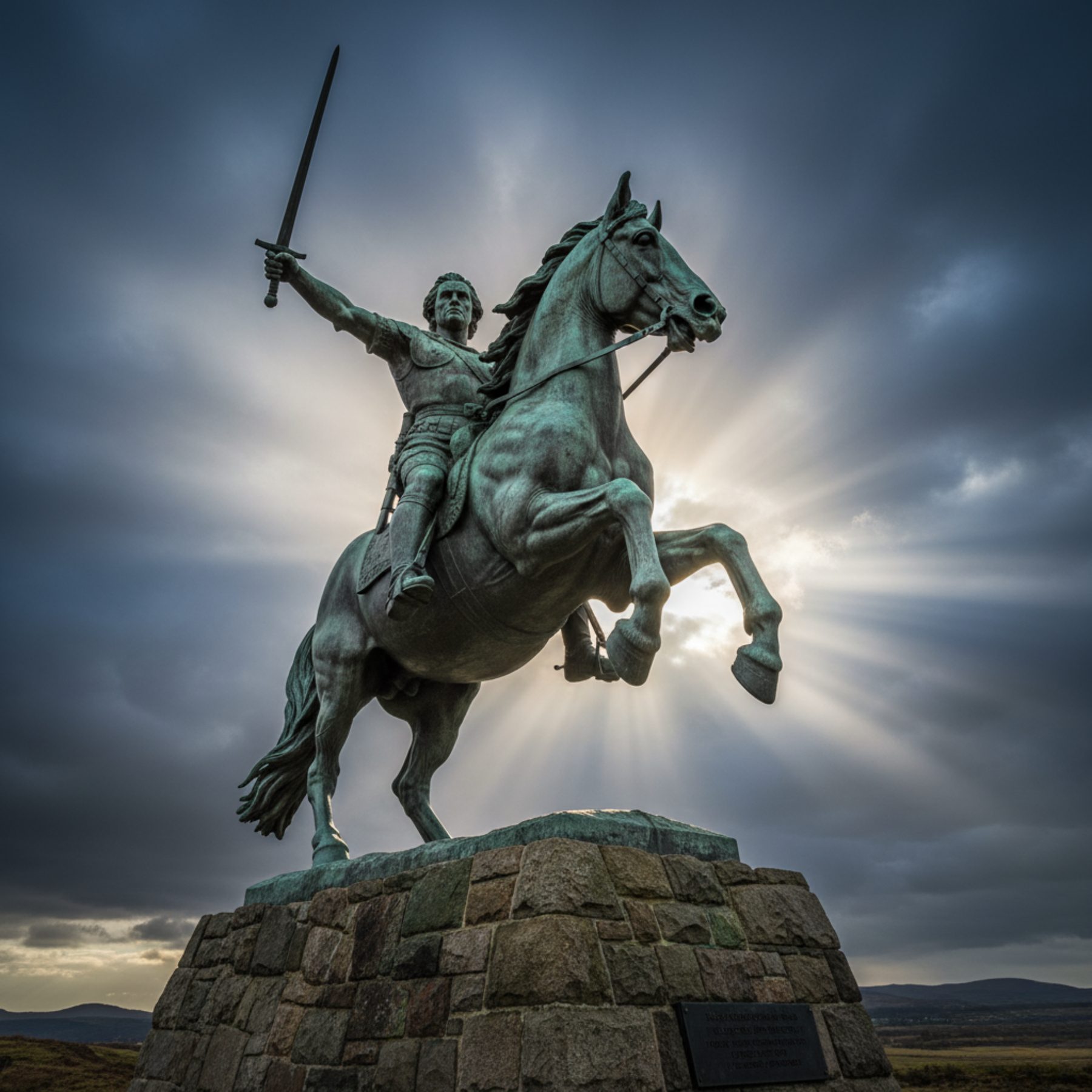
My family’s connection to Robert the Bruce is documented through genealogy. My grandmother’s maiden name was Dorothy Bruce, and the family line reaches back through the Bruce ancestry.
For a lifelong reader of history, architecture, and myth, that record feels like a map. It is one thing to study a figure who shaped a nation; it is another to know that his story is part of your own family history.
I have not yet made this heritage journey myself. The route below is the pilgrimage I am building: a path through the places where Robert Bruce moved from embattled claimant to Robert I, King of Scots, and where his legacy remains visible today.
The Outlaw King
The Spark of Rebellion
Robert Bruce’s path to the crown turned decisively at Greyfriars Kirk in Dumfries. On 10 February 1306, he killed his rival John Comyn during a confrontation there. The act left him exposed to both English punishment and Church condemnation. Weeks later, he was inaugurated as King of Scots at Scone.
His early reign brought defeat, flight, and the capture of members of his family. Bruce became a fugitive in his own kingdom before rebuilding his support through a long campaign.
The Spider and the King
Later tradition tells of Bruce hiding in a cave and watching a spider repeatedly attempt to cast its web. When it finally succeeded, the king resolved to try again. The episode belongs to folklore rather than contemporary record, but its endurance says something important: Scotland remembers Bruce not only for victory, but for persistence after failure.
Victory at Bannockburn
On 23 and 24 June 1314, Bruce’s army defeated the forces of Edward II at Bannockburn near Stirling. The victory was decisive, although England did not formally recognize Robert as king of an independent Scotland until 1328.
Bannockburn remains central to the story because it joins military strategy with landscape. Bruce chose his ground carefully and used the limits of the terrain against a larger English force.
The Journey of the Heart
Robert died in 1329. His body was buried at Dunfermline Abbey. His heart was removed for a planned journey to the Holy Land and, after that expedition failed, was returned to Scotland and buried at Melrose Abbey.
The division of body and heart gives the story a final layer of pilgrimage: one resting place for the king, another for the vow he could not complete in life.
The Royal Road: A Three-Act Journey
This route is not a checklist. It is structured as a three-act story, moving from rebellion to kingship and finally to legacy.
Act I: The Spark of Rebellion — Dumfries and Galloway
Begin in Dumfries, where the confrontation at Greyfriars changed the course of Bruce’s life. Continue into Galloway, where the landscape helped a fugitive king rebuild his campaign. Glen Trool brings the relationship between terrain and resistance into focus.
The act closes on the Ayrshire coast around Turnberry, closely associated with Bruce’s childhood and family. The exact location of his birth is not certain, but Turnberry Castle is widely regarded as the strongest candidate and remains essential to understanding his origins.
Act II: The Road to the Crown — Perthshire and Stirling
The second act moves to Scone, the traditional crowning place where Bruce was inaugurated in 1306, and then to the landscape around Stirling.
Bannockburn deserves time rather than a hurried stop. A specialist historian can help translate the modern landscape into the conditions of 1314 and explain why Stirling Castle mattered so much. Visitor facilities can change, so the current status of the experience should be checked before travel, while the memorial landscape itself remains a meaningful place to walk and reflect.
Act III: The King’s Final Rest — Fife and the Borders
The final act turns from conflict to remembrance. At Dunfermline Abbey in Fife, Robert’s body was laid to rest among Scottish monarchs. The abbey church remains active, so access to the tomb can vary around services and events.
Then travel south to Melrose Abbey in the Scottish Borders. Its ruins hold the memorial associated with Bruce’s heart. Together, Dunfermline and Melrose create a quiet conclusion: one place for the king, one for the journey entrusted to those who survived him.
Beyond the Battlefield: Myths in the Landscape
A Bruce itinerary also moves through the folklore of medieval Scotland. Lochs were imagined as the realm of kelpies, while hills and forests belonged to stories of the Fae. These traditions are not evidence for the events of Bruce’s life, but they reveal the imaginative world surrounding the places through which he moved.
That mythic layer matters to the journey. It helps explain why ruined castles, misted hills, and abbey stones can carry meaning beyond a date on a timeline.
Building a Heritage Journey of Your Own
For me, this route connects Dorothy Bruce, the documented genealogy, and the larger history of Scotland. It turns a family record into a sequence of places that can be walked, studied, and remembered.
A heritage journey does not require a royal ancestor. It might lead to the village a grandparent left, an archive that holds a family name, or a region whose food and stories survived in the family long after migration.
The best heritage itineraries balance research with practical pacing. They leave time for archives, local guides, changing site access, and the moments when a place means more than expected. That is the same approach Jamie brings to guided European journeys and to the wider planning philosophy described on the About page.
If you are ready to trace the geography of your own family story, begin the conversation.